Abhaneri and the Chand Baori Stepwell: Visitor Guide
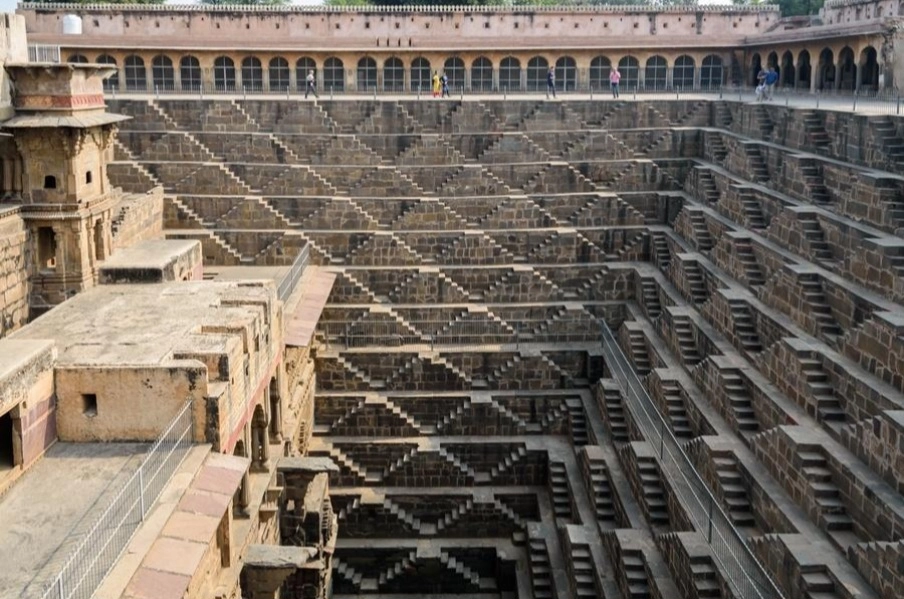
Abhaneri is a small village in Rajasthan's Dausa district, about 95 km east of Jaipur, best known for Chand Baori: a 13-storey stepwell with roughly 3,500 steps, built around the 9th century. Most travellers stop for about an hour on the road between Jaipur and Agra.
Why Visit Abhaneri
Chand Baori is one of the largest and deepest stepwells in India. Traditionally attributed to King Chanda of the Nikumbha dynasty, it was built to hold monsoon rainwater through Rajasthan's long dry season, and the air at the bottom stays noticeably cooler than at ground level. Thousands of narrow steps zigzag down three sides in a near-perfect geometric pattern, while the fourth side has a multi-storey pavilion with galleries and carved niches. Parts of the upper arcade were added much later, in the Mughal period.
It is a striking contrast to the Mughal monuments of Agra and the palaces of Jaipur, and one of the most photogenic places on the Golden Triangle route.
Top Attractions & Things to Do
How to Reach Abhaneri
| From | Distance (approx.) | Drive time (approx.) |
|---|---|---|
| Jaipur | 95 km | 2 hours |
| Agra | 160 km | 3 to 3.5 hours |
Abhaneri lies a short detour off the Jaipur–Agra highway, so it fits naturally into a road journey between the two cities. The nearest railway station is Bandikui Junction, but there is little public transport to the village, so nearly all visitors come by private car.
Adding Abhaneri to a Jaipur–Agra Drive
The easiest way to see Abhaneri is on a transfer day. A typical route is Jaipur → Abhaneri (about an hour's stop) → Fatehpur Sikri → Agra, or the same in reverse. It makes a full day, but it breaks up a long drive with two very different sights. Leave Jaipur early so you reach Fatehpur Sikri with enough daylight.
We arrange private cars and transfers for this route. Abhaneri can be added to our 5-day Golden Triangle tour, and it is a planned stop on our Rajasthan offbeat heritage tour through Bharatpur, Abhaneri and Bundi. For a one-way trip, send us your date on WhatsApp.
Best Time to Visit
October to March is the most comfortable time, with mild days and clear light. Early morning and late afternoon give the best light on the steps; at midday the well is in harsh shadow. From April to June it is very hot, so keep the stop short. During the monsoon (July to September) the well can hold some water.
Rajasthan Tourism holds the Abhaneri Festival, with folk music and dance at the stepwell, around September or October. Dates change each year.
Recommended Duration
Allow 45 minutes to an hour: about 30 minutes at Chand Baori and 15 to 20 minutes at the Harshat Mata Temple. Photographers may want longer.
Practical Travel Information
- The stepwell is open daily during daylight hours and charges a small entry fee at the gate, which is higher for foreign visitors. We confirm the current fee and timings when we plan your route.
- Facilities in the village are basic. Use the restrooms and restaurants on the highway before or after your visit.
- Dress modestly and take off your shoes at the temple.
- Photography is allowed around the stepwell.
- Abhaneri works best as a stop along a Jaipur–Agra (or reverse) road journey rather than a dedicated day trip.
Frequently Asked Questions
Abhaneri is famous for Chand Baori, a 13-storey stepwell with about 3,500 steps built around the 9th century, and the Harshat Mata Temple beside it.
About 3,500 narrow steps, arranged in zigzag flights over 13 storeys on three sides of the well.
No. The steps are fenced off to protect the monument. You view the stepwell from the galleries around the top.
About 95 km from Jaipur (around 2 hours by car) and about 160 km from Agra (3 to 3.5 hours), a short detour off the Jaipur–Agra highway.
45 minutes to an hour covers Chand Baori and the Harshat Mata Temple.
Yes, as a stop on a Jaipur–Agra drive rather than a standalone trip. Chand Baori is one of India's most striking stepwells.
October to March, in the early morning or late afternoon for the best light.